InnosoftGulf

Agentic AI Fundamentals and Practical Applications


Enrollment is Closed

Certificate Programme · Practical Agentic AI Development

Agentic AI Fundamentals and Practical Applications

Build practical AI agents in Python using local language models, structured outputs and approved tools.

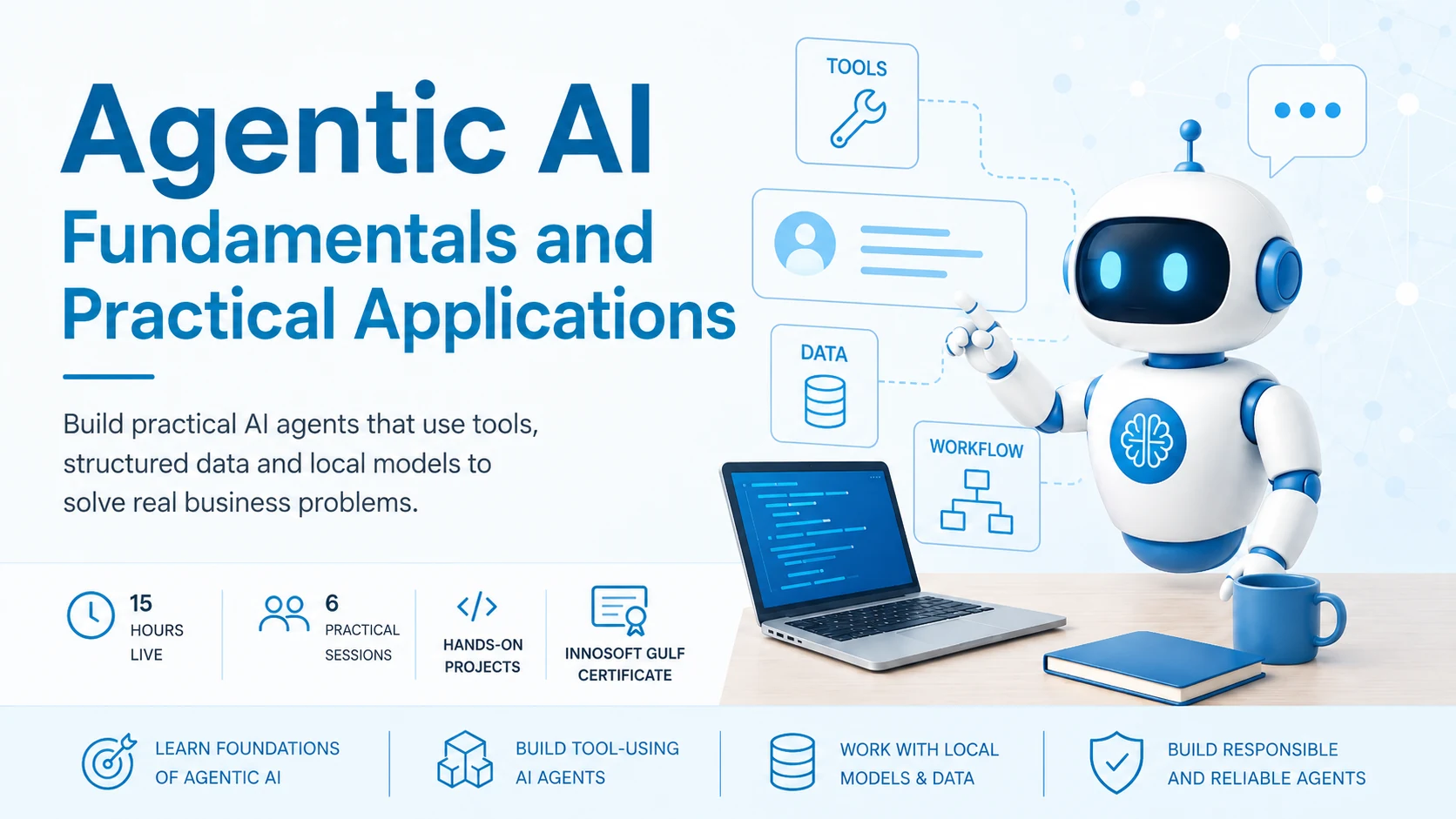
This hands-on programme introduces the foundations of Agentic AI and guides participants through the development of controlled, tool-using agents. You will learn how agents interpret goals, make decisions, use approved tools, validate outputs and operate within defined safeguards.

The programme combines structured lessons, live instruction, practical demonstrations and downloadable Jupyter exercises. It uses Python, local open-source language models through Ollama and managed development environments provided by Innosoft Gulf.


Quick facts

Duration
15 hours live
Format
6 practical sessions
Delivery
In-person or live online
Level
Beginner to intermediate
Certificate
Innosoft Gulf certificate
Focus
Local Models · Prompting · Validation · Tools

What you will build

During the programme, you will develop practical agent components that can:

Interpret a user goal and identify the required action
Use local open-source language models through Ollama
Follow clear prompts, roles, goals and constraints
Return structured outputs that can be validated by Python applications
Select and execute approved Python tools
Validate arguments and handle errors safely
Maintain a clear record of decisions, actions and observations

Curriculum

6 modules · guided demonstrations · practical notebooks · working tool-using agent

The programme progresses from a transparent rule-based Python agent to language-model applications that use local models, structured outputs, validation and controlled tool execution.

Module 1
Introduction to Agentic AI
  • Traditional software, generative AI, chatbots, workflows and agents
  • Goals, tools, state, observations and guardrails
  • The agent decision-and-action loop
  • Rule-based tool selection and execution
  • Audit trails, human approval and safety principles
Practical outcome
Build and test a transparent rule-based Python agent.
Module 2
Language Model Fundamentals
  • Tokens, context windows and next-token prediction
  • System, user and assistant messages
  • Temperature and response variability
  • Model strengths, limitations and hallucinations
  • Language models as agent decision components
Practical outcome
Interact with a language model and examine how prompts and settings affect its responses.
Module 3
Working with Local Models Using Ollama
  • Local and private language-model deployment
  • Ollama models, commands and APIs
  • Sending prompts from Python applications
  • Selecting models for different tasks
  • Privacy, cost and infrastructure considerations
Practical outcome
Run a local language model and call it from Python.
Module 4
Prompt Design for Agents
  • Roles, goals, constraints and expected outputs
  • Prompt templates for repeatable agent tasks
  • Few-shot examples and instruction hierarchy
  • Reducing ambiguity and unsupported assumptions
  • Testing and improving prompts systematically
Practical outcome
Design prompts that guide a model towards more consistent agent decisions.
Module 5
Structured Output and Validation
  • Why agents need structured output
  • JSON structures and explicit schemas
  • Validation with Python data models
  • Handling malformed or incomplete responses
  • Reliable communication between model and application
Practical outcome
Generate, validate and safely process structured model decisions.
Module 6
Tools and Function Calling
  • Designing approved Python tools
  • Tool descriptions, arguments and validation
  • Function calling and tool-selection patterns
  • Separating model decisions from execution
  • Error handling, safety checks and audit trails
Practical outcome
Build a language-model agent that selects and executes approved tools.

Practical learning environment

Participants work in managed development environments running on Innosoft Gulf’s private AI infrastructure. The practical labs include:

Jupyter-based Python exercises
Local language models through Ollama
Prompt design and model interaction
Structured output and validation
Approved Python tools and function calling
Error handling, audit trails and safety controls

Requirements

Participants should understand basic Python, including variables, conditions, functions, lists, dictionaries and simple error handling.

Previous experience with language models or Agentic AI is not required. Participants should be comfortable reading, running and modifying Python code in Jupyter notebooks.


Who this programme is for

Python learners and developers
Data analysts and data scientists
Technical consultants and solution architects
Professionals exploring practical AI agents
Technical managers and founders

Certificate

Participants who complete the course activities and practical exercises receive an Innosoft Gulf certificate of completion for Agentic AI Fundamentals and Practical Applications. KHDA attestation may be available where applicable.


Frequently Asked Questions

Is this course practical or theoretical?

The course is highly practical. Participants follow guided demonstrations, run Python code and complete downloadable Jupyter notebook exercises.

Do I need previous Agentic AI experience?

No. The programme starts with the foundations. Basic Python knowledge is required.

Will I use local language models?

Yes. The programme introduces local open-source language models through Ollama and shows how Python applications can interact with them.

What course materials can I keep?

Participants can download and retain the exercise notebooks. Solution notebooks are released progressively after the relevant exercises. 

How long will I have access to the course?

Participants receive access to the course material and practical lab environment during the whole programme.

Will I build a working AI agent?

Yes. The programme builds towards a controlled language-model agent that can interpret a goal, produce a structured decision and execute approved Python tools.